Posted by Mike Butler
on Tuesday, 25 February 2014
·

1. I’m Gonna Stay A Long, Long Time - Back Door
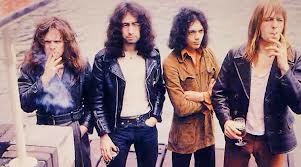
I often think of Back Door. Last night I dreamt I went to a Back Door gig again. I also dreamed that I was reading the obituary of Paul Rodgers, which proves that a) my powers of prophecy are rubbish (I hope), and b) Middlesbrough is on my mind.
But Back Door now. They maintained a residency (this is the legend) in a pub in a remote spot in the Yorkshire Moors, namely Blakey Ridge, and in this splendid isolation created an entirely sui generis concoction of jazz and blues. The trio comprised Ron Asprey, a melodic yet tantalisingly skewed soliloquiser on saxophone(s), Colin Hodgkinson, who arrived at the slapping, plucking and strumming bass style independent of Larry Graham and ahead of Stanley Clarke, and Tony Hicks, who generated tight polyrhythms on the drums.
With copies of a privately pressed LP as a calling card, they gained a slot supporting Chick Corea at Ronnie Scott’s and comprehensively blew the Spanish-tinged Scientologist off the stage. The subsequent buzz persuaded Warners Brothers to sign them. In short order the debut album was re-released in a gatefold sleeve, and the group were packed off to record in New York, where they received a tickertape parade welcome (actually a cheerful piece of pre-Photoshop got up for the cover of the second album, 8th Street Nights).
In fact, Back Door belonged to Middlesbrough. And so did I. Our paths crossed at a very surreal venue, the Little Theatre, on a very surreal bill - a Back Door and Stephane Grappelli co-header - on a very surreal evening: a street theatre troupe diverted bemused music-lovers outside the place. The next time I saw Back Door was at Redcar Coatham Bowl, on the launch of their third LP, Another Fine Mess.
No longer so sui generis, it’s clear (with hindsight) that they were in a line that extended back to Alexis Korner’s jazzy mid-sixties edition of Blues Incorporated (the one with Herbie Goins and Art Themen), and were kin to the likes of Colosseum and Dick Heckstall-Smith. Their new-found populism extended to honking ‘Dashing White Sergeant’ to a party rhythm. I was dancing on a tabletop at Redcar Coatham Bowl to this one. Honest!
Always happy to welcome back a vinyl revenant, my heart leapt when, a few weeks ago, I came across a tattered and dusty copy of Another Fine Mess. Musically, I'd pegged it as inferior to Back Door and 8th Street Nights, and the judgement holds, but there are plenty of enjoyable moments. I’d completely forgotten the opening song, ‘I’m Gonna Stay A Long, Long Time’, which strays from jazz to pop, and celebrates the hometown where...
... the food is really bland
And the air is funky
Back home in the 'Boro
It’s more self-deprecating than not (“We’ve got nothing really special in the ‘Boro”), which is probably the safest policy for ‘Boro apologists.
This set me thinking about other songs about Middlesbrough.
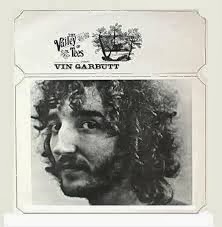
2. The Valley of Tees - Vin Garbutt
When I first heard this - quite early on, as my first paying concert was a triple bill of Iron Maiden (not that Iron Maiden), Vin Garbutt and Tudor Lodge at Middlesbrough’s Little Theatre around the time of Garbutt’s 1972 debut album, also called The Valley of Tees - the idea that songs could be written about places you knew struck me as incredible. This is a paean to the Cleveland Hills and beauty spots like Farndale, given implicit poignancy by the contrast to deprived areas like South Bank, where Garbutt grew up. It was also unusual to hear someone sing in a local accent, although Vin Garbutt’s delivery is so declamatory, and his phrasing is so gnarled, piling on embellishments with gusto and wildly stretching and modulating vowel sounds, I didn’t recognise the broad South Bank brogue.
3. Ring of Iron - The Teesside Fettlers
This, or the album of the same name, and The Best of the Seekers, were the only folk records in my dad’s record collection. It was doubtless purchased in a fit of local pride. The theme of 'Ring of Iron' is the same as ‘The Valley of Tees’, contrasting the blighted industrial landscape with the beautiful countryside nearby. The central image is arresting: the town, almost certainly Middlesbrough, is surrounded by a ring of iron that must be penetrated to break through to air and light. It was written by the late Graeme Miles, who specialised in songs of his native Teesside and was rewarded with a Gold Badge from EFDSS for his efforts.
A close relation is ‘The Chemical Worker’s Song’ by Teesside Fettler Ron Angel, which details the negative side of Back Door’s funky air. ‘The Chemical Worker’s Song' can be found variously on Ring of Iron by The Teesside Fettlers and The Young Tin Whistle Pest by Vin Garbutt.
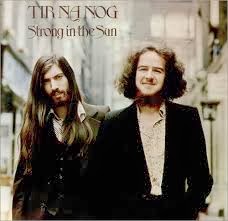
4. Teesside - Tir Na Nog
Not what I expected.
Leave your own sad Teesside
My love is like an ebb-tide…
Very fey I should say.
It comes from the 1973 album by the Irish duo, Strong in the Sun.
5. They Don’t Write ‘Em Like That Anymore - Vin Garbutt
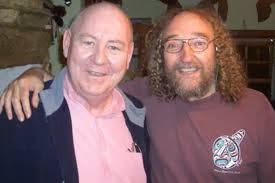
This fine song, a folk club standard, was written by Vin Garbutt’s mate and fellow South Banker Pete Betts (that's Pete and Vin above). It first appeared on Garbutt’s Tossin’ A Wobbler album from 1978, and has since been subject to a grab from the North West, with covers by The Houghton Weavers and Hanky Pank. Indeed, I first heard ‘They Don’t Write ‘Em Like That Anymore’ in a Lancashire pub in a rousing interpretation by John Howarth of Oldham Tinkers. It remains quintessentially Middlesbrough, however, treating of scatology and booze as much as nostalgia for pre-rock 'n' roll songs. Scatology and booze are the big ‘Boro themes.
6. Stainsby Girls - Chris Rea
A description of Middlesbrough schoolgirls from the viewpoint of a Middlesbrough schoolboy. It might fool outsiders, but anyone with first-hand experience of Stainsby Girls will know that Rea's song is absurdly romanticised. Stainsby Girls were as scary as anything from St Trinian’s. Having said that, my brother reminds me that both his ex-wife and her sister were Stainsby Girls, so I shall draw a veil over the subject.
7. Smoke of Home - Megson
Debbie Palmer of Megson comes from Middlesbrough whilst her partner, Stu Hanna, was born in Stockton - in North Tees Hospital to be precise - and lived in Billingham, so, strictly speaking, County Durham is his county. Yet Durham is closer to Teesside than to Newcastle, and, I noticed last time I was there, that Durham University seems to have colonised all of Stockton. After this justification for entry, 'Smoke of Home’, the title track of their 2007 debut album, concerns Mary who leaves her parents’ home in Billingham, catches a bus to Stockton and a train to Waterloo, and then on to the Continent, only to find disillusionment on the streets of France. Broke and homesick, she longs for “the smoke of home”.
8. The Procession - Graeme Miles
'The Procession' tells how a (fictitious) royal visit to open a new wing of Middlesbrough General Hospital turns into a riotous pub crawl, with lots of evocative references to Middlesbrough places and pubs - St Mary's, Ayresome, Baltic Tavern, Cannon Street (see below) - which are as obsolete now as evaporated milk (also name-checked). ‘The Procession’ can be found on The Teesside Fettlers' 1975 album, Travelling the Tees, and on a 1977 cassette, The Smokestack Land, by its author, Graeme Miles. Securing Miles' credentials as the Godfather of the Teesside Tradition, Travelling the Tees also contains 'The Moulder's Wedding', “a parody of cloth cap festivities” and his ‘Blue Sunset’ about the unexpected beauty of industrial pollution. The Smokestack Land contains ‘The Banks of the Tees’ (“waiting for the ferry at Middlesbrough”) and ‘Old Middlesbrough Market is Being Pulled Down’. Other ebullient accolades to Middlesbrough, this time by erstwhile Teesside Fettler Richard Grainger, are ‘Teesside and Yorkshire’ (yet more local pride from Travelling the Tees) and ‘Middlesbrough, The Klondike Song’, which tells of the goldrush that created the town after iron was discovered in the Cleveland Hills in 1850, as every Middlesbrough schoolchild kno.

9. Steel River - Chris Rea
If ‘The Klondyke Song’ is the beginning, 'Steel River' is the end. Guaranteed to break the heart of every Teessider, this evokes a Middlesbrough upbringing (the line about making love with a Carole King LP playing - presumably Tapestry, every home had one - is a nice period touch), and treats of the death of the steel industry and the dispersal of a generation. “Say goodbye, Steel River”. It’s the 'Boro’s answer to the Springsteen blue collar tragedy ‘The River’, and every bit as good.
10. My Brother Jake - Free
This might be pushing it, but I wouldn’t like to leave out Middlesbrough’s most famous son. I might also mention that I went to school with Paul Rodgers’ brother, Ged, and I once went around to his house in Saltersgill. Paul had moved on by then, although his traces could be detected in a record collection that contained every LP made up to that point by The Band (the first I was aware of them), alongside white label demos of early Free efforts. I always associate the song with Ged - it's a reasonable character study of the lad I knew - and might even substitute ‘Ged’ for ‘Jake’ if I sing it in my head. Perhaps because of the rough and ready piano, 'My Brother Jake' is the most offhand of all the Free classics, and hence the most soulful. The last time I saw Ged, he was enthusing about a new band he’d just seen called Dexy’s Midnight Runners, which tells you how long ago it was.

Note, the Top Ten omits ‘The Stars Fell on Stockton’. I relaxed the nothing-outside-Middlesbrough rule for Megson, but wasn't minded to do the same for The Shadows. ‘Alice in the Streets of Darlington’ by Claire Hamill is excluded for the same reason. Hamill’s One House Left Standing isn’t a song but the title of her debut LP. This is a pity, because now I can’t discuss the demolition of old Cannon Street or Record Tony’s theory that the true Middlesbrough accent (i.e. Record Tony’s) was special to Cannon Street residents and is now virtually extinct. So no go, even if the cover of One House Left Standing depicts Claire as a Victorian urchin surrounded by Middlesbrough iconography like wagon wheels, heavy cranes and the Transporter Bridge (especially the Transporter Bridge).
And ‘Middlesbrough Man’ by Maximo Park simply transposes the lyrics of Mark E Smith’s ‘Edinburgh Man’, so doesn’t count, at the risk of further jeopardising the North East-North West connection.
Posted by Mike Butler
on Wednesday, 12 December 2012
·
It can be a dispiriting business, selling folk LPs on eBay, when a wonderful and rare record like A Mayflower Garland by Cyril Tawney offered at the price of £5.99, in mint condition mind, attracts one watcher in all the the world. Even more dispiriting, he or she might snap it up at that price. Really, it's enough to make you examine your vocation.
So I thought I would change tactics and act like a proper dealer.
Q. What's the most collectable label in the world? A. Vertigo with the swirl label, of course. Q. And who is the biggest rock 'n' roll icon of them all? A. John Lennon, natch.
If there's any connection between Vertigo and John Lennon, I don't know of it, but I intend that the next two eBay offerings shall be the eponymous Black Sabbath LP from 1970, and John Lennon's Two Virgins from 1968.
In my book, the former is the definitive Sabbath album. The striking gatefold Keef cover and the hilarious sub-Dennis Wheatley sleevenotes just edge it over Paranoid.
Surely the famous Vertigo swirl is the most eye-catching label design ever. Roger Dean will live in infamy forever for designing the spaceship horror that succeeded it.
Alas, my copy is not in great nick, but the surface noise is consistently drowned out by industrial levels of heavy metal, and it only becomes an issue on the quiet bits (!), notably the tolling of the bell at the very beginning, and the spaces between the seven tracks, although where 'Sleeping Village' ends and 'Warning' begins has always been a deep mystery.
'Warning', lest we forget, was written by Lancashire blues legend Victor Brox. He once told me the story of how he first encountered the Sabbath version. It chanced to be playing as he and Aynsley Dunbar strayed into an 'underground'-style club sometime in 1970 (sorry, I'm a bit fuzzy on the detail, it would have been a hippy haunt like UFO or Middle Earth). 'Warning' had already been released as a single by The Aynsley Dunbar Retaliation. Hearing it blind, and presumably entering at a non- Ozzy moment, Victor assumed it was the Retaliation. He turned to Dunbar and remarked how he hadn't noticed that he (Dunbar) was having such an off-day when they recorded it.

As for Lennon, well Two Virgins was universally viewed as the ultimate rock-star folly. Essentially a sound collage like 'Revolution No.9' from White Album, though not as tightly structured, Two Virgins was criticised as unlistenable and self-indulgent, and a sad comment on Lennon's state of mind at the time. What interest it possessed was purely prurient (you can see Lennon's willie on the cover).
And yet… Well, you have to applaud the man's defiant experimentalism and marvel that 'She Loves You' was, what?, only five years distant. Some redeeming features: Yoko One remains the best screamer in the business (Fly is the one). Plus it offers insights into John's home-life and I think it's meant to be taken lightly: more Goon Show than Edgard Varèse.
Unfortunately this is a USA reissue, possibly from the eighties, with recurring surface noise almost certainly due to low quality vinyl stock. It's unlikely to have received much needle-time.
Sigh! Fortune my foe! That's an LP by Goliard by the way. On the Broadside label. 1978. Mint condition and a starting price of £5.99. Are there any takers?
Posted by Mike Butler
on Wednesday, 6 July 2011
·
A transient city. Pic by Louise Butler
Thursday, June 23
Say what you like, Glastonbury is a phenomenon! A medium-sized city - larger than the entire populace of South Yorkshire - springs up in the fields of Somerset for one week a year. It rises out of mud and returns to mud, and just a few short weeks after, it’s as if it were never there. Abandoned tents, latrines and the accumulated detritus of 180,000 thrill-seekers are cleared up. Only the sight of cows grazing in the shade of a pyramid hints that this is no ordinary English pastorale.
It’s a city of eternal youth, and a testament to the resilience, stamina and optimism of youth. On the Thursday before Glastonbury is properly underway, the ambience is more fairground than music festival. The background music is predominantly techno and the decor is distinctly Mad Max. Amiable anarchy prevails. Authority is largely confined to patrolling the perimeter fences. Indeed, like any other fair-sized city, there are genteel suburbs (the Healing Field, Kidz Field, Cinema and The Acoustic Stage) and shady no-go areas (the ironically named Shangri-La). Block 9, situated between Arcadia and Shangri-La, relocates an urban post-apocalyptic scene in the English countryside. It was here that I witnessed the single-most distressing spectacle of the Festival: a heavily pregnant girl, stoned out of her mind with headphones on, wading helplessly in the mud, clutching her stomach, dazed and beyond help.
Marijuana is flouted openly (there aren’t enough cells in Somerset to implement zero tolerance), but within my circle at least, the drug of choice is pear cider. The hit of this first, pre-concert evening is Ken Fox’s Wall of Death on The Common, with bikes and go-karts racing vertically around an eighteen-foot high cylindrical wall, pumping out noxious fumes to thrilled spectators. Brother Ant was so impressed he bought a t-shirt.
The Wall of Death. Pic by Louise Butler
The ultimate Glastonbury act, I muse, on this preliminary evening, before the music has even begun, must be Roy Harper, that madcap prophet and scourge of straight society. Glastonbury, indeed, might be Roy Harper’s dream made flesh. He treated of the subject on Glasto, from his 2000 album, The Green Man. It makes a great anthem: “Let’s go to Glasto and have us a blasto…” I don’t know why Michael Eavis doesn’t make Roy Harper an honorary patron and let him close the Festival every year. He is the exemplar of the rebellious crazed subversive, and the living embodiment of the adage that the path of excess leads to wisdom. In addition, Stackridge should open every Festival.
Friday, June 24
The God of Hellfire
And the other ultimate Glastonbury act is Arthur Brown, making only his second appearance in his own right, forty years after he stole the second Glastonbury Festival in 1971 (as documented in the Nicolas Roeg and Peter Neal film, Glastonbury Fayre). He wryly tells the crowd that, at this rate, he’ll be 109 at his next Glastonbury appearance. Brother Ant, however, maintains that Brown appeared at Glastonbury 2010 as the guest of Spatial AKA Orchestra, Jerry Dammers ‘ Sun Ra tribute band.
Brown actually put me mind of the great Sun Ra even before Ant vouchsafed this information. Rather, a cross between Sun Ra and William Blake. It’s the way arcane cosmology is placed at the service of a message of humanity. Imagination becomes a means of liberating the human spirit. So Sun Ra claimed to come from outer space, and William Blake saw the ghost of a flea and angels sitting in top branches of trees. That very morning, so Arthur told us, he saw an angel in a tree of the garden of his B&B in Pilton.
He possesses superhuman energy and is very sprightly for his age, dancing and capering and going through more costume changes than Beyonce (see below). The collective age of this edition of The Crazy World probably equals that of Brown alone, and they play with brio and virtuosity, and a full working knowledge of the tropes of psychedelia. Brother Ant recognised Time Captives from his old Kingdom Come album. And Fire Poem, the build-up to the inevitable Fire, was manically, deliriously freaky. Arthur endured a slight hitch - a roadie faltered during the lighting of his flaming helmet - with a gentle shrug that made him seem vulnerable. Then, within moments, the greatest showman of the psychedelic age had been transformed into THE GOD OF HELLFIRE. We were all going to burn, and we loved it!
The preceding act on the Spirit of ’71 Stage had been Edgar Broughton and his son, Luke, who demonstrated that the freak rock of those old Edgar Broughton Band albums concealed many good songs. Not a hint of Beefheart mannerisms (was that Steve Broughton?) and, to brother Ant’s disappointment, Apache Drop Out was nowhere in the programme. Indeed, the songs were overwhelmingly sombre and politically concerned, and disproved the notion that age inevitably brings a swing to the right. The full band belatedly joined Edgar and Luke for Out Demons Out, an exorcism targeted specifically at politicians and other creatures of the night.
Earlier, BB King looked very frail as he delivered his greatest hits (3 O’Clock Blues, The Thrill is Gone, etc.) from a sitting position. It was an act of reverence on the part of the Pyramid Stage audience, made poignant by the awareness that this was, in all likelihood, the very last chance to see a true blues legend. The same thought occurred to King, who revived Blind Lemon Jefferson’s One Kind Favour (“…please see that my grave is kept clean”) for the occasion.
The low-point of the day was young Sam Duckworth, whose radicalism seemed callow and self-satisfied compared to the old school anarchism of Edgar Broughton). One suspected that, like his comrades in the sessions in the Left Field tent organised by Billy Bragg, he was there principally to make the compere look good.
My Glastonbury actually started with verbals. That morning, as part of the self-styled Free University of Glastonbury (at HMS Sweet Charity, in The Park) ) Jon Ronson, was holding forth about psychopaths in that self-deprecating, ingratiatingly geeky way he has. Following Ronson, Mark Thomas explained why he didn’t want to be remembered as the man who sent Nelson Mandela back to jail. Thomas could give Bragg a lesson in mixing polemic with wit. Between Ronson and Thomas, I stepped out and saw Dylan Le Blanc’s band perform a credible Shape I’m In.
And that was my first full day at Glastonbury. I might add that a piss, a falafel and a pear cider can work wonders in restoring life to flagging flesh. I missed U2 but managed to see two or three songs from Cee-Lo Green. Horrible R&B cliches pumped up with horrible Black Sabbath riffs. I suppose every generation gets the ‘soul voice’ it deserves.
Saturday, June 25
Unka and niece. That is, Mike and fraulein Katherine with Lisa. Pic by Louise Butler
Today was a day of discovery. I discovered what Marcus Brigstock looks like in person, allowing for a Victorian handlebar moustache (grown to play Mr Perks in a production of The Railway Children); I discovered that today was Phil Juputus’ birthday (both insights gleaned from a casual visit to the Cabaret tent); I discovered that, whereas pear cider was freely available, apple cider was virtually unknown at Glastonbury; I discovered that Lau, who gave a stunning performance in the Avalon tent, are the best folk group in the world (Modern Division). Inflections from modern systems music were better assimilated and more rousingly delivered than, say, The Brandt Brauer Frick Ensemble, who we had just left on the West Holts Stage. I discovered, or rather, had my suspicion confirmed, that Pentangle are the best folk group in the world (Sixties to Present Division). Honestly, they conjured magic in the Acoustic Tent. Their distinct weave of MJQ-style chamber jazz and English traditional folk has never been surpassed for grace, melody and delicate swing- what a tasteful drummer Terry Cox is! - with Danny Thompson as the wild card, and McShee and Renbourn as envoys for a much older and mysterious tradition. What a blessing they’re all still with us, in a week that saw the death of Mike Waterson (Billy Bragg had earlier dedicated Hard Times of Old England to him). True, they didn’t break new ground, confining themselves to old favourites like A Maid That’s Deep in Love, Cruel Sister, Light Flight, Wedding Dress etc, but the music they produce is perfection: entire, fully achieved and sui generis.
I discovered what it felt like to lose oneself in a crowd of thousands, and share collective waves of euphoria, squishiness and abandonment (this was entirely novel to me, as a non-football supporter). This, when the mighty Elbow essayed the finest stadium rock yet devised by Man(cunuan), managing the trick of being simultaneously rousing and sensitive.
Further, I discovered that a set by Murray L. Young doesn’t bear repetition and that Spliff Richard is a poet I can rely on to express unarticulated thoughts about social cohesion, the war and tribute bands. I discovered that souk music goes down very well with souk food: I visited the Moorish food stall for the second consecutive day (‘Moorism’, was it?) as the strains of Omar Souleyman came drifting over from the West Holts Stage (“aaaaaaaAAAAAAAA!”).
It was a day that constantly flirted with disaster, with the ever-present possibility that exhaustion and befuddlement might finally override intelligibility. I’m happy to report that the forces of good prevailed and that Terry Reid got through his set without falling offstage or being attacked by the sound crew. Reid is a garrulous drunk subject to mercurial mood swings - the worry that he might never start a song was followed by the worry that he might never finish one - but the superlungs are just about intact, and no-one else can immerse himself in a performance like Terry Reid. It was a spellbinding, raw, edgy performance.
I discovered that the adage (quoted above) - about the path of excess leading to wisdom - should always be accompanied by a health warning. Mick Farren mixed beat-inspired poetry with impossible proto-punk with The Deviants back in the sixties, and is still ardently champions free love, chemical recreation and political insurrection. As brother Ant said, “Christ, this guy is in worse shape than B.B. King.” Where else could it be but the Spirit of ’71 Stage?
Sunday, June 26
For me, the heart of Glastonbury still resides in hairy-arsed hippy music, and I make no apology for preferring the Spirit of ’71 to the stadium-style Pyramid or supersized Other Stage. I missed seeing Fleet Foxes and Mumford & Sons, but if I had my time over, I would still go to see Edgar Broughton and Arthur Brown instead. But here are alternative impressions of Glastonbury, from my beloved niece Katherine, to do honour to the multiplicity of Glastonbury. There is a different Glastonbury for every person who attends.
The Queens of the Stone Age: “A proper rock band. The laser show was amazing. They haven’t had a record for six or seven years… They really ramped up the build-up by playing part of the Songs For The Deaf album. The place went bananas. The lead singer had a brilliant swagger. Pulp were amazing…” (Pulp were unannounced special guests) “Jarvis Cocker is a proper showman. I was transported back to 1995.”
U2: “Bono, why do you have to be a twat all the time? He had a conversation with a voice in the sky. I thought that was quite twat-like behaviour. Chemical Brothers worked everyone up into a frenzy. They had a trippy backdrop, and every now and then a scary clown face would come up. I mean, people are already going to be out of their boxes. The last thing you want to do is mess with them.”
“It would have been great to do Beyonce with my friends, because that’s how I enjoy her - her music is the soundtrack to my life. But Queens of the Stone Age are a bit more personal.”
Ah yes, Beyonce… but I’m getting ahead of myself. The first indispensable musical offering of the final Sunday of Glastonbury, not counting a pointedly strenuous display of campanology coming from the Pilton Parish Church of St John the Baptist, was Jah Wobble and the Nippon Dub Ensemble on the West Holts Stage. What started as an unlikely melange of King Tubby and Kabuki, with a hint of the Kodo Drummers, gradually turned into a corking set of Lovers’ Rock and toasting, with invaluable contributions from Candice Gabbidon (father Basil was on guitar) and - here’s a welcome return - Ranking Roger! During a euphoric and extended I’m Still In Love With You, the penny dropped: Glastonbury is a glorious celebration of the human spirit. It transcends age, culture, gender: if you can still access that first sense of absolute joy, then Glastonbury will open its arms to you. Negativity of any kind runs counter to the Glastonbury spirit. So, sorry Sam Duckworth; sorry Bono (on Katherine’s behalf), sorry B.B. I’m Still In Love With You was my choice for the unofficial anthem of Glastonbury 2011, beating close competition from One Day Like This by Elbow, and Haitian Fight Song/Goodbye Pork Pie Hat by Pentangle.
Unfortunately this state of bliss didn’t survive a workmanlike set by The Popes. Ron Sexsmith tried valiantly to overcome the unvoiced sentiment of the majority of the Avalon crowd (“we hope you realise we could be watching Paul Simon now”) and, with hindsight, the Avalon people probably made the right decision. Self-effacing, fey and introspective, Sexsmith offers a kind of tenderness that would be impossible to replicate for mass consumption. Indeed, Katherine reported that Simon was lacklustre, and this was later corroborated by an impartial witness who watched the TV broadcast.
However, there was now dissent and full-scale rebellion among the troops. “Your Robyn Hitchcock is shit,” declared brother Ant, returning with a couple of beakers of pear cider. “I was passing the Spirit of ’71 Stage and he was murdering Too Much Time.” (The programme mentioned that Hitchcock would be playing two albums from 1971, so he must have been re-enacting Captain Beefheart’s Clear Spot; Ole Tarantula might have been a better choice.) A splinter-group from our little party went off to find The Vaccines, leaving some of us (me) to stay behind for Show of Hands. This was that rare thing: stadium-rock folk music. I know because people started waving their arms in a spontaneous manner (even Guy Garvey needed to prompt the Pyramid masses). The righteousness of SOH sometimes grates, but passion and sincerity eventually win the day.
By evening, enough good-will had returned for us to join the multitudes gathering for the much anticipated, hotly debated Festival finale: the Glastonbury debut of Beyonce. Brother Ant was game - he had been converted by Jay-Z’s appearance a few years ago. I was curious, willing to sample the opiate of the masses. However, as the minutes dragged on, and Beyonce still didn’t appear (I made excuses on her behalf: being late is the prerogative of the diva). Then, the extravaganza belatedly kicked in - with fireworks, a madly gyrating dance troupe and soul-shrivelling razzmatazz all designed to perpetuate a pre-teen credulity in make-believe and fantasy. With one mind, we hastened to the only competition in town: NY songstress Suzanne Vega in the Acoustic Tent. Actually Vega treats of the same subject matter as Beyonce - the vagaries of feminine desire, I suppose - but does so on a more modest scale and with more recognisable humanity. Would Beyonce know who Carson McCullers was, much less write an off-Broadway musical about her?
That was my Glastonbury, and it ended on a note of intriguing, kooky NY femme understatement.
The last word goes to John, a merchant seaman who ekes out his retirement far away from the sea at brother Ant’s house in Pilton. John was my benefactor: residents of Pilton are given gratis tickets, and this got me passed the highwire fences and security guards that represent the real-life protectors of the dream city. John was talking about his adventures - he was a captive of Mao in China’s Cultural Revolution - and far-flung travels. He mentioned a trip to Central Mongolia. “I wouldn’t say I actually enjoyed Central Mongolia, but I’m very glad I went,” he said, nailing my own feelings about the past weekend, if you substitute ‘Glastonbury’ for ‘Central Mongolia’.
Posted by Mike Butler
on Tuesday, 13 July 2010
·
Carlton Club, Manchester, Monday 12 July
The sound of Spaceheads occupies the margins between trance dance, free jazz and psychedelia. It comprises of Andy Diagram's blissed-out trumpet - electronically enhanced by loops, echoes, octave doubling and fractal patterning - and Dick Harrison's drums, locating rhythm and pulse with every crash and bang, and serving as the perfect launchpad for Diagram's kosmic klaxon.
They've been away for too long, doing things that come to all of us in time - raising families, planting trees, reforming James etc. So there was a preponderance of old tunes in the set, and a welcome chance to revisit dislocated dancefloor faces like Trance Figure 8.
Improvising comes as second nature to Spaceheads, and the search for fresh discoveries began in earnest when the duo were joined by Orchestre Marcel Duchamp's Vincent Berthelet on bass. Making fresh discoveries and striking vital grooves are not mutually exclusive activities for Spaceheads. It comes as a shock to realise that Diagram's tabletop of wires and wonder, so state-of-the-art twenty years ago, now seems actually primitive. Older spectators may feel nostalgic for a time when rave culture could embrace two men armed with technology, brio and imagination, intent on replicating the impact of Bitches Brew with just trumpet and drums. Their light show, meanwhile, was quaintly redolent of Pink Floyd at Middle Earth, circa 1967.
The sensibility of headliners Orchestre Tout Puissant Marcel Duchamp is post-punk, and the instrumentation is appropriately bizarre - trombone, marimba, fiddle, guitar, drums and double-bass. Their surreal affiliations are not only signposted by the name but by a resolute rejection of all musical and social convention. Singer and violinist Liz Moscarola is the model of charming, aggressive femininity, alternately little-girl-lost and barking. She proclaims emotional vulnerability in evocative yet oblique stanzas. I didn't understand a word ("the house is coming"?) yet was profoundly moved. The rhythm team of Anne Cardinaud and Wilf Plum generated a clattering yet well-calibrated groove. Big-toned trombonist Seth Bennett is one of the loudest brass men in the business: conversely, the light-toned guitarist Mael Saletes is one of the quietest grunge guitarists in the business.
Orchestre Tout Puissant Marcel Duchamp are surreal in the true sense: more than art, it's a way of life; of living on the edge of your senses. The players perform with a conviction that, in other circumstances, would be dedicated to fringe religion. And their music defines the epithet so beloved of Patti Smith: 'beauty will be convulsive or not at all." Very romantic. Very subversive. Very Gallic.
Posted by Mike Butler
on Sunday, 14 February 2010
·
The Deaf Institute, Manchester, Thursday, Feb 4
The UK tour coincides with a 2CD set, 30, a collection to commemorate thirty years of Dutch punk group, The Ex. This counts as longlife in anyone's book; obviously something so strong could not readily be relinquished. Enjoyment pervades the music, which is surprising because the starting point is that patented punk emotion, anomie. But broad smiles, glee as guys crashed into each other, the general delight in clangour and the belief that even apocalypse can to be taken lightly were all redeeming qualities of punk.
The Ex maintain this tradition. They add something new. A feeling of adventurousness, perhaps, and a willingness to engage in all kinds of unlikely alliances. In the early nineties, they hooked up with the late Tom Cora, an improvising cello-player with the eloquent tone of a classical musician. Here, it's the turn of Brass Unbound, a gang of hardcore internationalist free-jazzers, and, it must be admitted, the collaboration is a triumph.
How does it work? The guys mesh guitars in three-part formation, each playing a integral though discrete part. They interlock, or drop in and out, or crash into one another, but all with a sense of spaciousness, rare in punk. At the centre of it all, and preventing any hint of stasis, is drummer Katherina Bornefeld, surely one of the best drummers in the world. When Katherina locks into a groove, it stays locked. She is a whole Burundi drum choir in one.
The singer, Arnold de Boer, is barking and shouting, and slipping in and out of trance, like an Ian Curtis with the secret of joy. State of Shock, ostensibly about inner-city alienation, becomes something else - a cry of ecstasy.
The combination of form, freedom and surrender fits nicely into the jazz improv aesthetic. Brass Unbound - individually Mats Gustafsson, Roy Paci, Ken Vandermark and Wolter Wierbos - fling themselves into the music, literally in the case of trombonist Wierbos, who pogoes and whirls as to the manner born. Paci's trumpet, in a higher tonal register than his brassy playmates, cuts through the rumble like a scythe. He sometimes resembles a mariachi musician, in his declamatory majesty. Perhaps the single most compelling moment of the show came with Gustafsson's unaccompanied baritone solo: it's unlovely tone and primal force reminded of a regenerate Albert Ayler.
Punk and free jazz, on this occasion at least, were ideal bedfellows. It seemed that their combined strengths - of passion, innovation and intuition - cancelled out the supposed weakness of free jazz. There were no longueurs with Kath about. And then there were the interludes when she sang, and a kind of East European folksiness entered the proceedings. The Ex seem open to anything: the braying polyphony of the horns even had the spirit of New Orleans, albeit a wildly abandoned and fierce parallel-universe-New-Orleans. Suddenly this viewer had a vision of a new kind of jazz fusion: one that simultaneously celebrated and shredded all the music that had gone before. Seriously, it was a gig of a lifetime.